
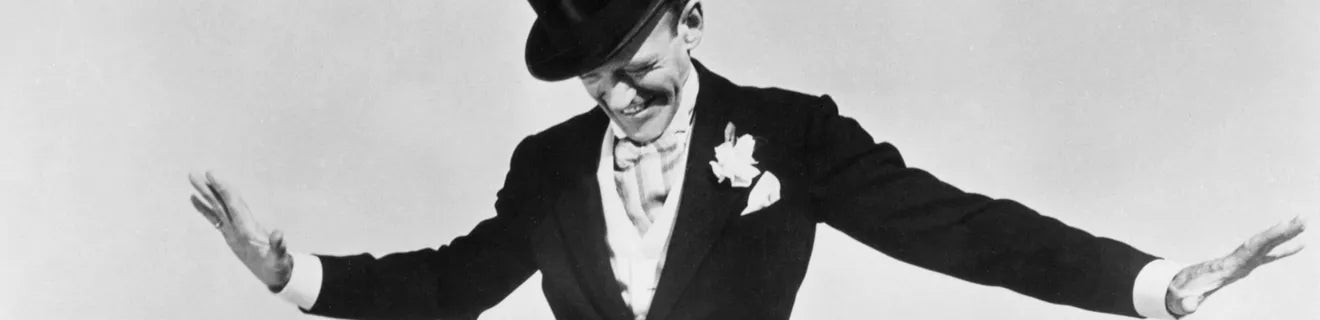
Biography Of Mr. Fred Astaire
Fred Astaire, born Frederick Austerlitz II in 1899, began show business at the age of four, performing on Broadway and in Vaudeville with his older sister, Adele. As a young adult, he headed to Hollywood where he began a successful partnership with Ginger Rogers for nine movies. He appeared in films with esteemed co-stars such as Joan Crawford, Rita Hayworth, Ann Miller, Debbie Reynolds, Judy Garland, and Cyd Charisse. He also co-starred with the biggest actors of that time, including Bing Crosby, Red Skelton, George Burns, and Gene Kelly. Fred Astaire was not only a great dancer – changing the face of the American movie musical with his style and grace – but he was also a singer, and an actor with many different dramatic and comedic credits, in both movies and TV specials. Fred Astaire also changed the way dance sequences in movies were filmed, insisting that the focus be kept on the full-frame dancers and the dance steps themselves, using a stationary camera shot – with long takes, wide shots & as few cuts as possible, allowing audiences to feel as though they were watching a dancer on stage, versus the then-popular technique of using a constantly roving camera with frequent cuts and close-ups.

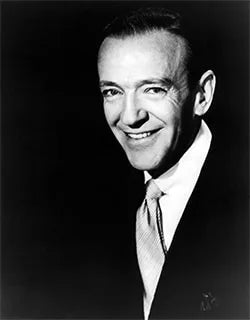
Astaire received an honorary Academy Award in 1950 for his “unique artistry and his contributions to the technique of musical pictures.” He holds choreography credits for ten of his movie musicals released between 1934-1961, including “Top Hat”, “Funny Face”, and “The Pleasure of His Company”. He won five Emmys for his work in television, including three for his variety shows, An Evening with Fred Astaire (1959, which won an unprecedented nine Emmys in all!) and Another Evening with Fred Astaire (1960).
In his later years, he continued to appear in movies, including “Finian’s Rainbow” (1968), and “The Towering Inferno” (1974) which earned him an Oscar nomination. He also starred in television roles on programs such as It Takes a Thief, and Battlestar Galactica (which he said he agreed to, due to the influence of his grandchildren). Astaire also lent his voice to several animated children’s TV specials, most notably, Santa Claus Is Comin’ to Town (1970), and The Easter Bunny is Comin’ to Town (1977). Astaire received a Lifetime Achievement Award in 1981 from the American Film Institute, who in 2011, also named him the “Fifth Greatest Actor” (among their “The 50 Greatest Screen Legends (opens in a new tab)” list).
Fred Astaire died in 1987 from pneumonia, at the age of 88. With his passing, the world lost a true dancing legend. His effortless lightness and grace may never be seen again. As Mikhail Baryshnikov observed at the time of Fred Astaire’s death, “No dancer can watch Fred Astaire and not know that we all should have been in another business.”
Fred Astaire’s Dance Partners
Although most famous for his magical partnership with Ginger Rogers, Fred Astaire was truly the king of movie musicals, with a film career that spanned 35 years! Astaire paired with dozens of the most famous dancers and movie stars of his time, including:
- Gracie Allen1895 – 1964
- Lucille Bremer1917 – 1996
- George Burns1896 – 1996
- Joan Caulfield1922 – 1991
- Barrie Chase1933
- Joan Crawford1904 – 1977
- Virginia Dale1917 – 1994
- Vera-Ellen1921 – 1981
- Joan Fontaine1917 – 2013
- Paulette Goddard1910 – 1990
- Audrey Hepburn1929 – 1993
- Betty Hutton1921 – 2007
- Gene Kelly1912 – 1996
- Ann Miller1923 – 2004
- Janis Paige1922
- Eleanor Powell1912 – 1982
- Marjorie Reynolds1917 – 1997
- Kay Thompson1909 – 1998
- Adele Astaire1896 – 1981
- Jack Buchanan1891–1957
- Leslie Caron1931
- Cyd Charisse1922 – 2008
- Petula Clark1932
- Bing Crosby1903 – 1977
- LeRoy Daniels1928 – 1993
- Nanette Fabray1920 – 2018
- Judy Garland1922 – 1969
- Rita Hayworth1918 – 1987
- Harriet Hoctor1905 – 1977
- Olga San Juan1927 – 2009
- Claire Luce1903 – 1989
- George Murphy1902 – 1992
- Hermes Pan1909 – 1990
- Jane Powell1929 – 2021
- Ginger Rogers1911 – 1995
“For ballroom dancing, remember that your partners have their own distinctive styles also. Cultivate flexibility. Be able to adapt your style to that of your partner. In doing so, you are not surrendering your individuality, but blending it with that of your partner.
– Fred Astaire, from The Fred Astaire Top Hat Dance Album (1936)
Fred Astaire Films & TV Specials
During his career, Fred Astaire starred in 12 stage performances, 8 dramatic films, 16 television programs, and 33 musical films, including:
- Flying Down to Rio1933
- The Gay Divorcee1934
- Roberta1935
- Top Hat1935
- Swing Time1936
- Follow the Fleet1936
- A Damsel in Distress1937
- Shall We Dance1937
- Carefree1938
- The Story of Vernon and Irene Castle1939
- Broadway Melody of 19401940
- You’ll Never Get Rich1941
- Second Chorus1941
- Holiday Inn1942
- You Were Never Lovelier1942
- The Sky’s the Limit1943
- Blue Skies1946
- Yolanda and the Thief1946
- Ziegfeld Follies1946
- Easter Parade1948
- The Barkleys of Broadway1949
- Three Little Words1950
- Let’s Dance1950
- Royal Wedding1951
- The Belle of New York1952
- The Band Wagon1953
- Daddy Long Legs1955
- Silk Stockings1957
- Funny Face1957
- An Evening with Fred Astaire1958
- On the Beach1959
- The Pleasure of His Company1961
- The Notorious Landlady1962
- Finian’s Rainbow1968
- It Takes a Thief1968–1970
- Midas Run1969
- Santa Claus is Comin’ to Town1970
- The Towering Inferno1975
- Battlestar Galactica1978-1979
- Ghost Story1981
Songs Introduced by Fred Astaire
Fred Astaire introduced many songs by famous American composers that became classics, including:
- Cole Porter’s “Night and Day” from The Gay Divorcee (1932)
- Jerome Kern’s “Nice Work If You Can Get It” from A Damsel In Distress (1937) and “A Fine Romance,” “The Way You Look Tonight,” and “Never Gonna Dance” from Swing Time (1936)
- Irving Berlin’s “Cheek To Cheek” and “Isn’t This A Lovely Day” from Top Hat (1936) and “Let’s Face The Music And Dance” from Follow The Fleet (1936)
- Gershwins’ “A Foggy Day” from A Damsel In Distress (1937) and “Let’s Call The Whole Thing Off,” “They All Laughed,” “They Can’t Take That Away From Me,” and “Shall We Dance” from Shall We Dance (1937)